
The Gate That Never Opens
When Chinese sports media talk about 发育关 "the puberty gate", what are they really saying?

Content note: this article contains descriptions of disordered eating behaviours in elite sport.
China is never short of diving champions, but Quan Hongchan 全红婵 is one of a kind. At the Tokyo 2020 Olympics, she was 14 years old, competing in her first international event and scoring perfect tens to win a gold medal. The Chinese internet became fascinated with her immediately: her flawless dives, her straightforward way of dealing with the public, and the story of a girl from a rural family becoming her household’s breadwinner.

Quan went on to claim more medals in the Paris cycle, including two more golds at the Olympics. At the age of only 19, Quan has already collected both world titles and Olympic golds in her discipline, but she also decided to take a break from the sport that once made her famous.
Nineteen is considered young in most elite sport disciplines, but not in Chinese women’s platform diving. Chinese athletes have dominated the event since the turn of the century, yet the women who take gold are almost never older than twenty. The one exception is Chen Ruolin 陈若琳, who won a synchronized platform gold at Rio at the age of 23. By then, the Chinese press had already started calling her a veteran.
Chinese audiences are well acquainted with watching women platform divers peak young and retire soon. They are also familiar with the idea that women platform divers will hit a performance wall during puberty, when weight gain and height growth disrupt the technical precision they have been building since they were kids.
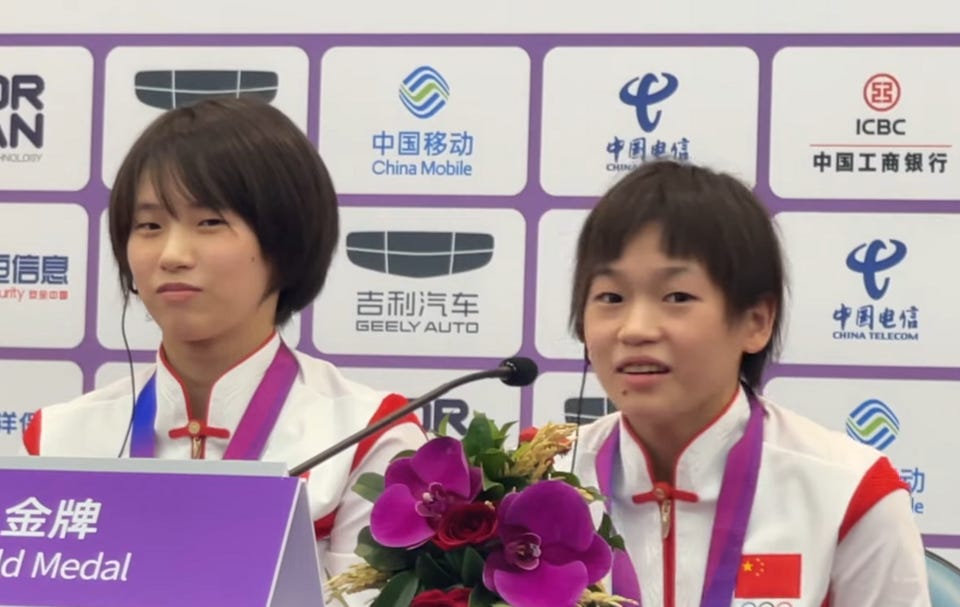
In a recent interview with 人物, Quan told a similar story. She experienced puberty only after Paris 2024. When she returned to the national team in late 2024, she found herself surrounded by comments about her weight and people calling her fat. She had been controlling her weight strictly, and still she felt estranged from her own body, whether on the diving platform or in front of a mirror. The changes had shaken her confidence in the movements she had spent her life perfecting.
Recounting her return to the national team in late 2024, Quan told 人物:
“At every World Cup I competed in, every comment I heard came back to the same word: fat. Everyone knows that weight is every women's platform diver's nightmare. I cared so much about my own weight too... Eventually it left a psychological scar. I became terrified of the scale. I didn't dare step on it. Every time I looked in the mirror, I felt so fat, so bulky... During training, I was scared of every single dive, even the dives I'd never feared before, I was suddenly scared of them. It wasn't a physical fear. It was psychological.”
The interview prompted a wave of reflection on Chinese social media: about the culture of diving and other weight-sensitive disciplines like gymnastics and figure skating, about the cost borne by women athletes, about who gets to comment on an athlete’s body and why. But the conversation also circled around a concept so familiar in Chinese sports that it rarely gets examined: 发育关, or the puberty gate. The character 关 carries the meaning of a gate or checkpoint: it is something to pass through, to be hindered by.
The term is so embedded in Chinese sports discourse that it has become a foreseeable future for all the women athletes who have yet to hit puberty and a blanket explanation for the decline in performance that comes after. It constructs a seemingly coherent narrative, yet the paradox at its heart is hard to miss: the puberty gate makes women athletes’ lived experience of puberty visible, while it often reduces this experience into a simple narrative of the athlete “overcoming” body changes with sheer determination during that time. Everything else, like what her body actually experienced during that transition, what support she needed and received, how she might work with her changing body rather than fighting against it, disappears into the gate.
Much of the narrative surrounding the puberty gate has focused on weight. Body changes, in this framing, are essentially a weight management problem: athletes must watch the scale, restrict their intake, and maintain something close to their pre-puberty form. This looks like the only way to get through the puberty gate, but restricting energy intake during adolescence is not simply a matter of discipline — it poses a risk. Sports medicine now recognises disordered eating behaviours and chronic energy restriction as warning signs for Relative Energy Deficiency in Sport (REDs), a condition recognized by the International Olympic Committee as a serious threat to both athletic performance and long-term health. When a young athlete reports constantly weighing herself or skipping meals to keep an “ideal” weight, the story being told about her should not be one of admirable work ethic. Instead, we should ask whether the system around her has fulfilled its duty of care, and what it means that this culture continues to be passed down to the next generation of athletes, and to the young women watching them.
A Xinhua (the official state news agency of China) profile of diver Chen Yuxi 陈芋汐, titled "Chen Yuxi's Heroism," described her daily routine in admiring detail:
“She lives a life of near-mechanical precision: her weight strictly controlled at 42.5 kilograms, never exceeding 43. She weighs herself ten times a day, carries a food scale everywhere, and takes ‘only a few bites of vegetables’ at family meals.”
Zhang Jiaqi 张家齐, a former teammate of both Quan and Chen, described her own experience in a post-retirement interview with 人物:
“I was hungry every single day. When I couldn't take it anymore, I'd eat a little. But mostly I just endured. Controlling those urges was incredibly hard. I wanted to eat. My body was growing and needed that energy. But I had to suppress that instinct. When I really wanted cake, I'd put it in my mouth but not swallow. I'd chew it and spit it out. It helped a little — at least I got to taste it.”
What the puberty gate narrative also tends to obscure is that puberty is not only a period of weight change, but also a critical window for bone and muscle development. The framing fixates on what needs to be controlled, while ignoring what needs to be built. Bone density and muscle mass, established during adolescence, form the physical foundation an athlete will rely on throughout her career and are also crucial to injury prevention. An athlete who restricts her nutrition to maintain a lighter frame during this period is not just managing her weight. She is also quietly compromising structures that cannot easily be recovered later.
The gaps in this narrative become clearer when you look at how individual athletes’ experiences have been told. When swimmer Ye Shiwen 叶诗文 went through puberty after her extraordinary performance at London 2012, the story was told largely through the lens of weight gain: her body had become heavier, her technique had been affected, and her results had declined. What went unexamined were the questions that a more rigorous framework would have demanded: what was her training load and recovery like during this period? What nutritional support was she receiving? How was the team around her responding to the mental pressure of early fame alongside physical transition? More than a decade later, when the twelve-year-old Yu Zidi 于子迪 burst onto the scene, Chinese commentators and audiences were already reaching for Ye’s story as a warning, as if the only lesson worth drawing from one athlete’s experience was that the next one should expect to suffer the same way.
There are athletes who have moved through puberty and continued to compete at the highest level, but their trajectories tend to be treated as exceptions rather than evidence that the prevailing approach might be wrong. When gymnast Deng Yalan 邓娅兰 said publicly that her secret to still competing in her mid 20s (rare for Chinese women gymnasts) is that she does not diet to control her weight, the response was not to ask what her experience might suggest about how all athletes could be better supported. It was to explain her away: she is a vault specialist, power matters more than weight in her discipline, her case does not apply. The framework absorbed the anomaly and stayed intact.

This is what the puberty gate, as a concept, ultimately does. It reduces the complex transition an athlete is going through during puberty into a single metric - weight, and places the challenge entirely on the athlete. The system around her, the coaching guidance, the nutritional support, the duty of care owed to an adolescent athlete whose body is still developing, disappears from the story. In the end, the gate is not just something for women athletes to pass through; it is something that closes off every harder question beyond it.
Further reading:
The science of female puberty in elite sport, how physical development intersects with training, performance, and long-term health for women athletes, remains an evolving field. Last year, when I was working on a Chinese commentary piece on the puberty gate and weight management in elite sports, I came across this opinion piece by Alexi Pappas, a runner and Olympian. Her idea provides a different (and powerful) approach to understanding the impact of female puberty for elite women athletes.
Female Athletes Need to See Puberty as a Power, Not a Weakness